
Predictive AI Analytics Solutions (Zoho)
Forecast Smarter. Reduce Risk. Unlock Future Insights.
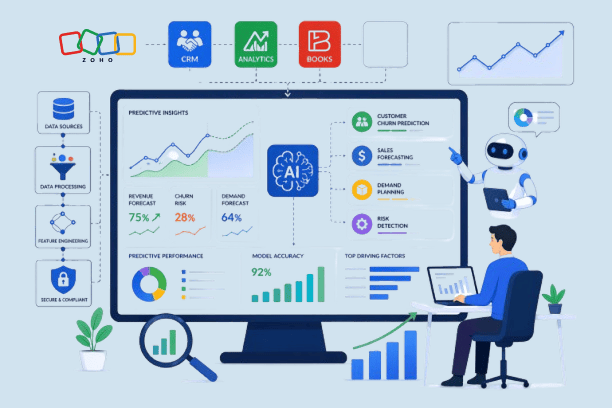
Move from Reactive to Predictive Decision-Making
Most businesses rely on historical data, limiting their ability to anticipate future outcomes. With Zoho-based Predictive AI Analytics, you can leverage machine learning models on your existing data to predict customer behaviour, forecast sales, and optimize operations, giving your business the ability to act before challenges arise.

Predictive Analytics Expertise

Machine Learning Models

Secure Data Processing

Zoho Ecosystem Integration

Implementation & Model Deployment

Scalable Analytics Solutions
What We Offer: End-to-End Predictive AI Analytics Services
Analytics Strategy & Data Assessment
We evaluate your data and define predictive use cases aligned with your goals.
Data readiness assessment
- Use case identification (churn, demand, pipeline)
- Predictive analytics roadmap
Zoho Integration & Dashboarding
We integrate predictive insights into your Zoho ecosystem.
Zoho CRM and Zoho Analytics integration
- Real-time dashboards and reporting
- Automated data pipelines
Model Development & Training
We build machine learning models using your business data.
Custom predictive model development
- Data preparation and feature engineering
- Model training and validation
Monitoring, Optimization & Support
We ensure models remain accurate and relevant over time.
Model performance monitoring
- Continuous improvement and retraining
- Ongoing analytics support

The Challenge: Reactive Decision-Making
Without predictive insights, businesses often struggle to anticipate trends and make informed decisions, leading to missed opportunities and inefficiencies.
Reactive Decision-Making: Businesses depend on past data instead of anticipating future outcomes.
Customer Churn Uncertainty: Difficulty identifying customers at risk of leaving.
Unreliable Sales Forecasts: Limited visibility into pipeline performance and conversion trends.
- Poor Demand Planning: Inaccurate forecasts result in excess inventory or stock shortages.
- Limited Data Expertise: Teams lack the capability to build and interpret predictive models.
The Solution: Data-Driven
Predictions with AI
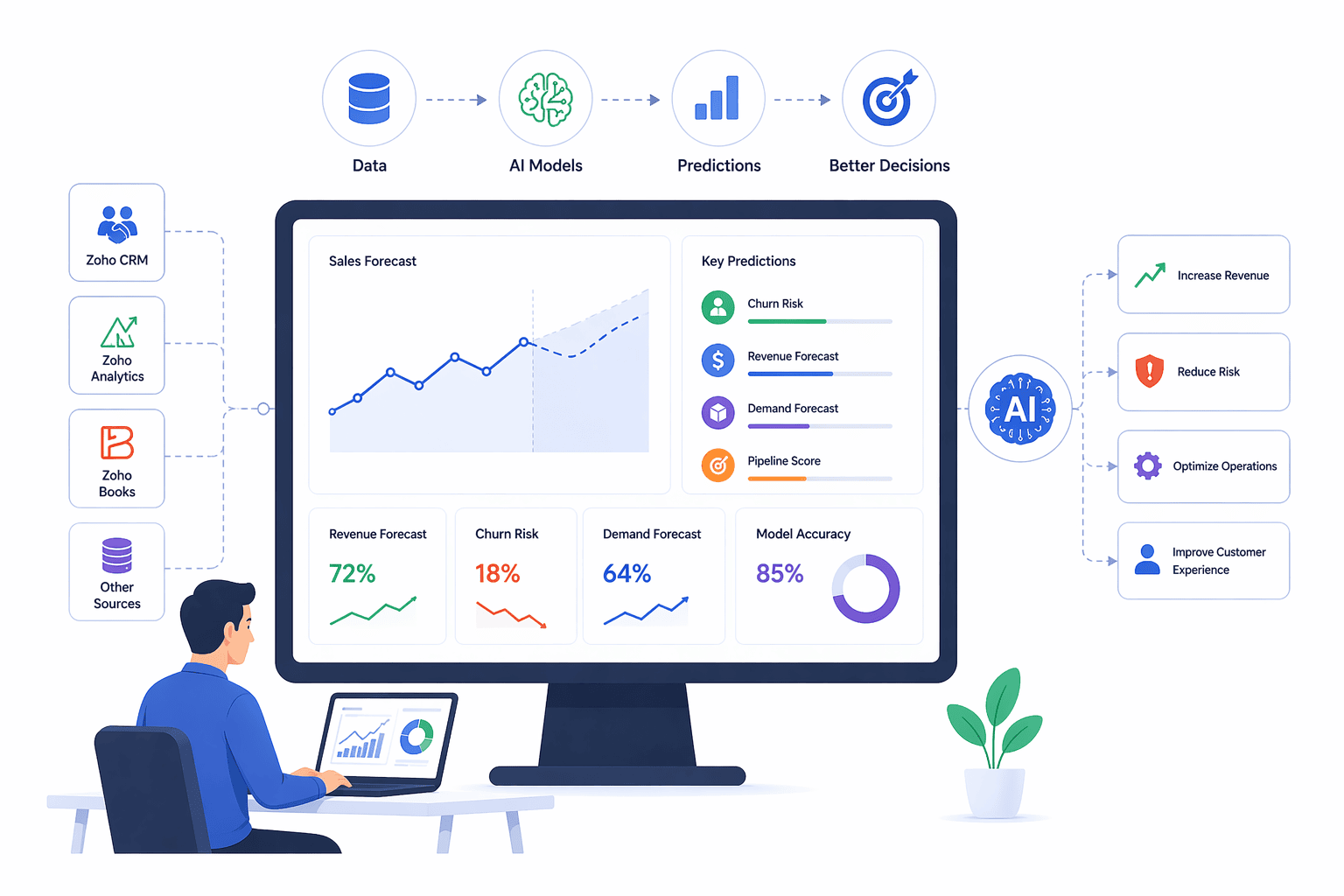
Predictive analytics empowers businesses to make smarter decisions by using machine learning to uncover patterns, forecast outcomes, and prioritize actions.
Custom ML Models: Build predictive models tailored to your business data.
Churn Prediction Insights: Identify at-risk customers and take proactive retention actions.
Pipeline Scoring: Prioritize high-value leads and opportunities with intelligent scoring.
- Demand Forecasting: Predict future demand to optimize inventory and supply chains.
- User-Friendly Dashboards: Visualize predictive insights through intuitive dashboards.
Key Use Cases for Predictive AI Analytics

Customer Churn Prediction
Identify customers likely to disengage and implement proactive retention strategies.

Sales Forecasting
Predict revenue trends, pipeline performance, and conversion rates.

Inventory Demand Planning
Forecast product demand to maintain optimal stock levels.

Lead Scoring
Rank leads based on their likelihood to convert, improving sales efficiency.

Predictive Maintenance
Anticipate equipment failures and reduce downtime in operations and logistics.
CASE STUDIES
Our Case Studies
 |  |
Digitally Transforming Custom Manufacturing Operations with Low-Code
| |
Achieving Operational and Financial Harmony with Xero & Zoho
Integration
Growing businesses often find themselves using specialized tools for different functions, Zoho for sales, operations, and customer engagement, and Xero for accounting and financial management. While both platforms are powerful individually, the lack of integration between them leads to duplicate data entry, delayed financial insights, and misalignment between teams. Integrating Zoho and Xero bridges this gap—creating a unified, real-time workflow between operations and finance.
| |
Transforming Nonprofit Data Management with Low-Code Technology
A nonprofit organization dedicated to supporting underserved communities, particularly those relying on sign language, was facing major challenges with data tracking, reporting, and program management. Their mission to provide accessible services and education was being held back by inflexible tools and manual processes.