
CRM Transformation
Transforming Lead Management & Sales Efficiency
For a Leading Multi-Region Jewellery Retailer
Executive Summary
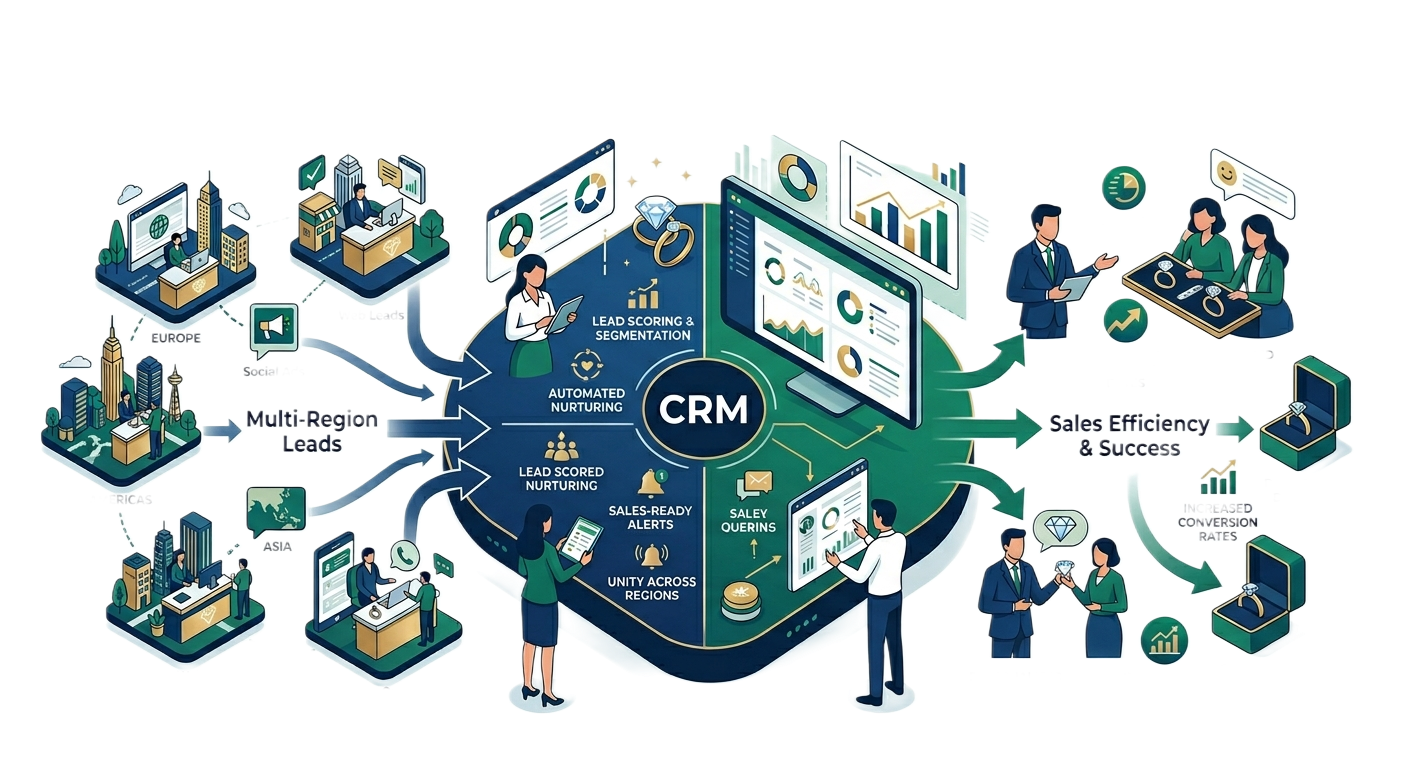
A large, rapidly expanding jewellery retail chain with hundreds of outlets across multiple regions was struggling to manage the high volume of franchise inquiries generated through its website. The business had ambitious growth targets but lacked the systems to capture, classify, and convert these inquiries efficiently.
After implementing a fully customised CRM and marketing automation solution, the organisation achieved 100% automated lead capture, eliminated lead leakage, cut response times by 85%, and saw a 35% uplift in deal closures - all within 90 days of go-live.
Six headline outcomes — in 90 days
Every metric improved across the board. Here's what the implementation delivered within three months of go-live.
Client Overview
The client is a premium jewellery retailer operating hundreds of showrooms across multiple states and regions. Known for its wide product range, the brand had built a loyal customer base over decades and was actively pursuing a significant franchise expansion programme.
As part of this expansion, the company's website served as the primary channel for franchise inquiries. Prospective franchisees and property owners would submit inquiry forms expressing interest in opening new outlets or leasing sites. The volume of these submissions had grown considerably - but the process to handle them had not kept pace.
Challenges
Before the CRM implementation, the franchise inquiry process was fragmented, slow, and entirely dependent on manual effort. The table below summarises the key pain points identified during the initial assessment:
7 critical problems before implementation
| Challenge | Description & Business Impact |
|---|---|
| Manual Data Entry | Website inquiries manually transferred to spreadsheets — creating significant delays, human errors, and duplicated records that wasted sales team time. |
| Slow Response Times | Follow-ups delayed by 48–72 hours, significantly reducing inquiry-to-conversion rates. Prospects disengaged before the sales team could reach them. |
| No Lead Categorisation | Inquiries not classified by type (franchise vs. property), priority level (hot/warm/cold), or geographic region — causing all leads to be treated with equal urgency. |
| Lead Leakage (~20%) | Approximately one in five inquiries was lost entirely due to gaps in the manual process — never entered into a system or actioned by the team. |
| No Leadership Visibility | Management had no dashboards or reports to track inquiry volumes, conversion trends, regional performance, or individual sales executive activity. |
| Uneven Workload Distribution | Without structured assignment rules, some sales executives were overwhelmed while others were underutilised — reducing overall team performance and morale. |
| Unreliable Forecasting | Absence of pipeline data made staffing plans, inventory decisions, and expansion sequencing largely guesswork — creating risk across the entire growth programme. |
The diagram below illustrates how inquiries moved (or failed to move) through the old manual process, highlighting where lead leakage and delays occurred:
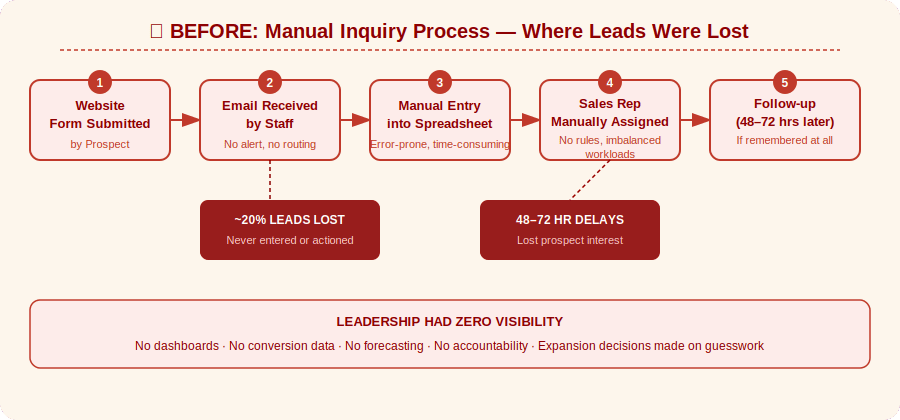
Collectively, these issues meant that the organisation was losing roughly one in five potential franchise opportunities before they could even be acted upon. Leadership had no reliable data to understand where leads were falling through or to make informed decisions about expansion priorities.
Solution
Following a thorough needs assessment, a customised CRM and marketing automation system was deployed to address each of the identified challenges. The implementation was designed to be scalable, future-proof, and tightly aligned with the organisation's operational workflows.
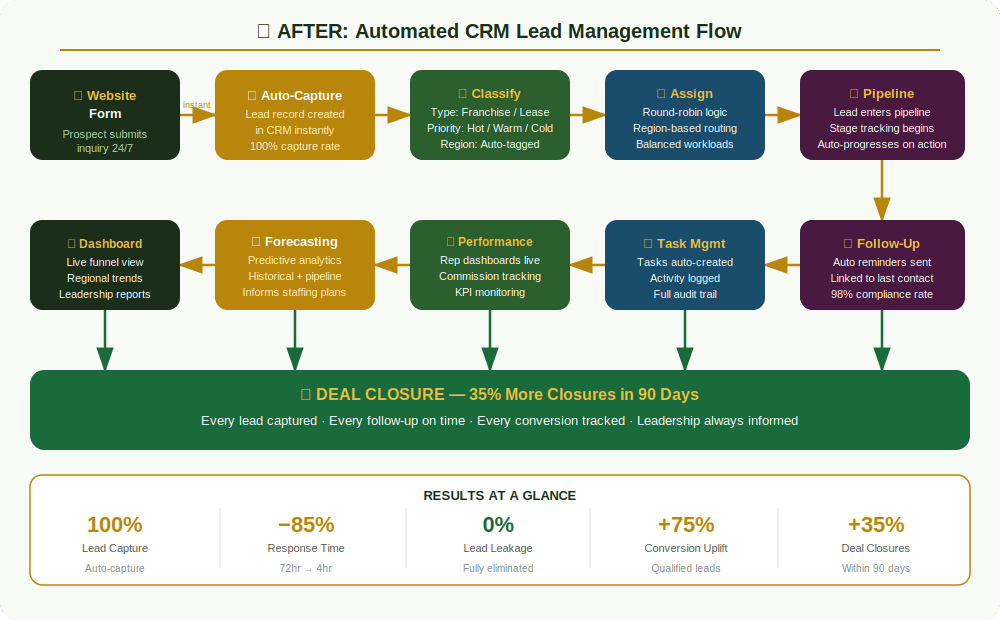
8 capabilities delivered by Zentix Software
Automated Lead Capture
All website inquiry forms directly integrated with the CRM. Every submission automatically creates a new lead record with complete contact details — eliminating manual data entry entirely. Lead capture rate reached 100% immediately.
Lead Classification & Assignment
Custom data fields categorise each inquiry by type and temperature (Hot, Warm, Cold). A round-robin and region-based assignment engine distributes leads equitably across the sales team, preventing workload imbalances.
Sales Pipeline Design
A multi-stage pipeline tracks each lead from initial inquiry through to deal closure. Automated workflows move leads between stages based on defined engagement criteria — no opportunity sits idle.
Follow-Up Automation
Automated reminders and nudges configured for each sales executive, linked to lead status and last-contact date. High-priority leads trigger escalation alerts, ensuring timely and consistent follow-through.
Executive Performance & Commission Tracking
Individual dashboards monitor each executive's activity, pipeline contribution, and conversion rates. A commission-tracking module calculates and reports incentive payments accurately and transparently.
Sales Forecasting
Predictive analytics built on pipeline and historical data enable leadership to forecast deal closures by region and time period — giving senior management confidence for staffing, inventory, and expansion sequencing.
Task Management & Activity Logging
Automated task creation linked to each pipeline stage. Every meeting, call, and follow-up logged against the relevant lead or deal — providing full accountability and a clear audit trail for management review.
Real-Time Reporting & Dashboards
Custom dashboards built for operational and executive audiences. Sales managers monitor inquiry volumes, pipeline velocity, and team performance in real time. Leadership accesses regional trend reports and conversion summaries at a glance.
Six-stage lead-to-closure pipeline
Automated workflows progress leads between stages based on engagement criteria, reminders triggered at each stage, commission tracked at closure, and every action logged in real time.
Results — 90 Days Post-Implementation
Within 90 days of go-live, the organisation recorded significant improvements across every key performance indicator tracked by leadership.
| Metric | Result | Business Impact |
|---|---|---|
| Lead Capture Automation | 100% | All inquiries captured instantly — zero missed submissions |
| Response Time Reduction | −85% | From 48–72 hours down to under 4 hours for every inquiry |
| Lead Leakage Eliminated | 0% | Zero lost inquiries post-implementation — leakage fully closed |
| Sales Conversion Uplift | +75% | Higher qualified lead conversions through pipeline structure |
| Follow-Up Compliance | 98% | Consistent, timely follow-through — automated reminders |
| Deal Closure Increase | +35% | More franchise deals closed within the same 90-day period |
Beyond the numbers, the implementation fundamentally changed how the sales and franchise development teams operated. Sales executives shifted from reactive, spreadsheet-driven work to proactive, data-driven engagement. Leadership gained real-time confidence in pipeline health and forecasting accuracy for the first time.
Key Learnings & Takeaways
This transformation offers several lessons directly applicable to other jewellery retailers or franchise-driven businesses:
Manual inquiry handling is a significant hidden cost
Even when a process appears to work, fragmentation and delays erode conversion rates in ways that are difficult to quantify without CRM data. The gap between perceived performance and actual performance is often larger than leadership expects.
Lead classification is foundational
Treating all inquiries equally wastes sales capacity. Simple categorisation by type, region, and priority dramatically improves team efficiency and ensures the highest-value opportunities receive the fastest attention.
Speed of response is a competitive differentiator
Reducing response time from 72 hours to under 4 hours directly increased conversion rates. Prospects who receive prompt engagement are significantly more likely to progress — in franchise sales, urgency and momentum are everything.
Automation enables scale
The business could not grow its franchise network without systems that could handle increasing inquiry volumes without a proportional increase in headcount. Automation removed the ceiling on growth entirely.
Visibility drives accountability
When leadership can see pipeline health and individual performance in real time, the entire sales culture shifts towards higher standards of follow-through. Transparency creates performance — and performance creates results.
Conclusion
This case study demonstrates that a well-executed CRM and marketing automation implementation can fundamentally transform sales efficiency and franchise growth for large-scale jewellery retail businesses. By combining intelligent lead capture, automated classification and assignment, pipeline discipline, and real-time reporting, the organisation moved from a reactive, error-prone process to a proactive, data-driven engine for growth.
The results - achieved in just 90 days - highlight the speed at which operational impact is possible when technology is deployed with a clear understanding of business workflows and growth objectives.
For jewellery retailers and franchise businesses looking to scale, this implementation serves as a proven model: the right CRM strategy, properly executed, does not just improve administration - it becomes a direct driver of revenue growth.