
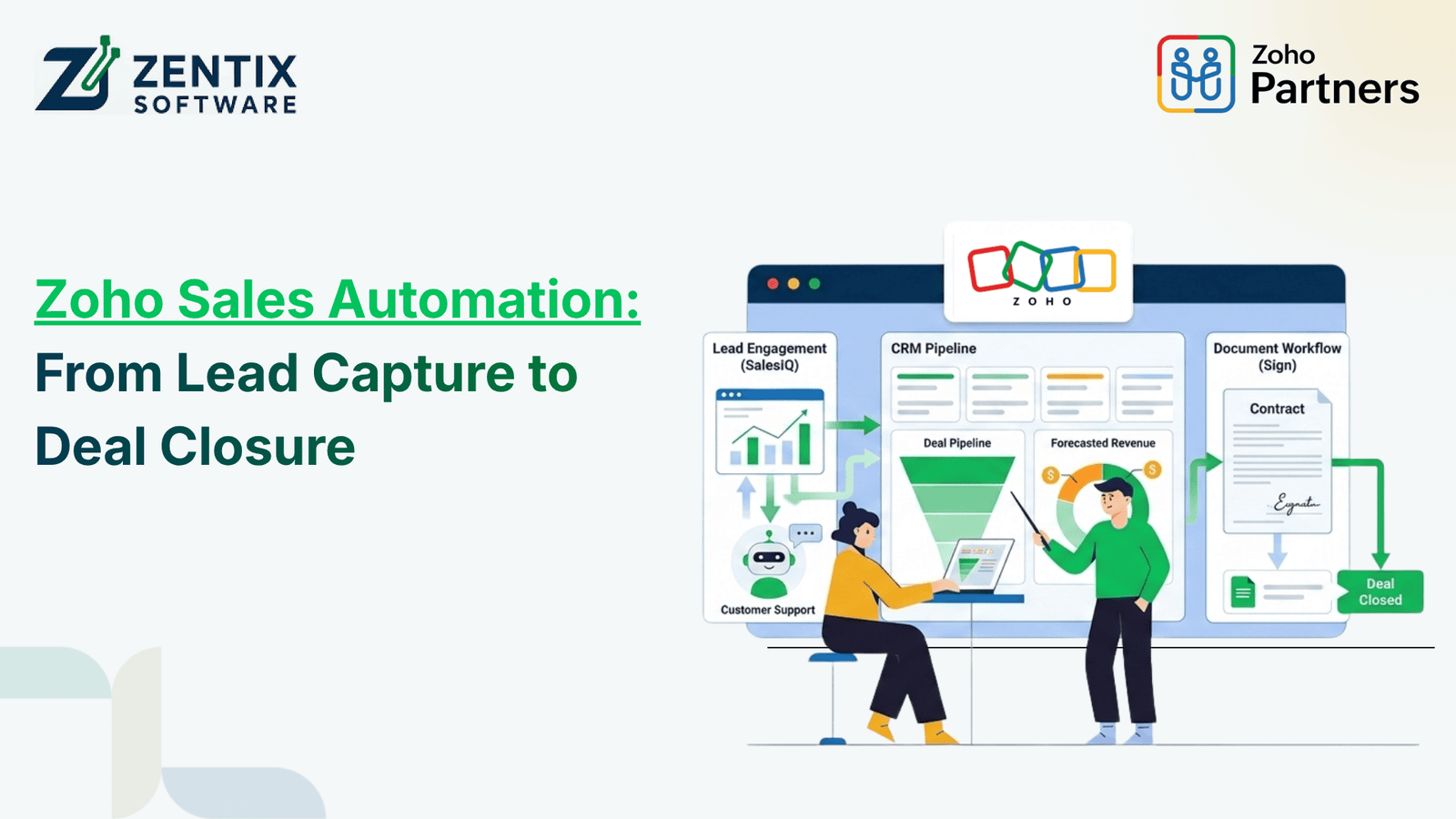
Sales teams today handle more leads, customer conversations, and more follow‑ups than ever before. In my experience, as a business grows, managing all of this manually can become difficult. Salespeople may spend hours updating records, checking spreadsheets, sending follow‑up reminders, and preparing reports instead of focusing on prospects.
This is where Zoho sales automation can help.
With Zoho CRM, businesses can bring sales activities into one centralized system and automate repetitive tasks throughout the customer journey. From capturing a lead to qualifying prospects, managing opportunities, and closing deals, automation helps create a more organized and consistent sales process.
For businesses looking for CRM solutions, Zoho offers the flexibility to build a sales environment that fits their specific processes rather than forcing them to completely change the way they work.
What Is Zoho Sales Automation?
Zoho sales automation is the use of Zoho CRM's automation features to simplify repetitive activities involved in managing leads and sales opportunities.
A typical sales team may need to repeat the same activities, such as entering lead information, assigning prospects, scheduling follow-ups, updating deal stages, and preparing sales reports.
Instead of handling every activity manually, businesses can automate suitable parts of the process.
This allows sales representatives to spend more time understanding customer requirements, having meaningful conversations, and moving qualified opportunities toward a purchase.
The important point is that sales automation does not replace the salesperson. It reduces repetitive administrative work so the salesperson can concentrate on the parts of selling that require human interaction.
Why Is Sales Automation Important for Growing Businesses?
A small sales team may be able to manage leads manually when there are only a few inquiries every day. However, as lead volume increases, manual processes can quickly become difficult to manage.
For example, a business may receive inquiries from its website, social media, advertising campaigns, referrals, and email. Keeping track of all these prospects in different spreadsheets or applications can make it difficult to know which leads have been contacted and which ones still need attention.
This can result in:
Missed follow-ups
Slow responses to new leads
Inconsistent sales processes
Duplicate data entry
Poor visibility into sales opportunities
Difficulty tracking sales performance
Leads being forgotten
More administrative work for sales teams
A centralized CRM with automation can bring these activities together and give sales teams a clearer view of their entire sales pipeline.
Read Next: Zoho CRM for Everyone: No More Missed Customers
How Zoho CRM Supports the Sales Journey
The biggest advantage of Zoho sales automation is that it can support multiple stages of the sales cycle rather than focusing on just one activity.
Let's look at how this works in a practical business environment.
1. Capture Leads From Different Sources
Every sale begins with a potential customer.
Leads can come from website forms, online advertising, social media, email campaigns, events, referrals, or direct inquiries. When these leads are managed separately, sales teams can easily lose track of important information.
Zoho CRM allows businesses to centralize lead information in one place.
When a potential customer submits an inquiry through a website form, for example, their details can be captured in the CRM. Sales teams can then access relevant information about the prospect without searching through emails or spreadsheets.
This gives businesses a more organized starting point for the sales process.
2. Organize and Manage Lead Information
Capturing a lead is only the beginning. Sales teams also need to understand who the prospect is, what they are interested in, and whether they are likely to become a customer.
Zoho CRM provides a structured place to store important customer and lead information.
Sales representatives can view details such as contact information, company details, communication history, lead source, and other relevant information from one system.
Having this information available makes it easier for salespeople to understand the prospect before starting a conversation.
It also reduces the need for repeated data entry across different tools.
3. Identify the Most Valuable Leads
Not every lead has the same level of interest.
Some prospects may simply be exploring their options, while others may already be comparing vendors and looking for a solution.
This is where lead qualification becomes important.
Zoho CRM can help businesses evaluate and prioritize leads using criteria that are relevant to their sales process. Lead scoring can also help sales teams identify prospects that show stronger buying signals.
This allows salespeople to spend more of their time on opportunities that are more likely to progress.
Rather than treating every inquiry in the same way, businesses can create a more focused sales approach.
4. Keep Follow-Ups Consistent
Following up with prospects is one of the most important parts of sales.
However, when salespeople are managing dozens of prospects at the same time, remembering every follow-up can become challenging.
Zoho CRM can help sales teams organize follow-up activities and maintain a consistent communication process.
Tasks, reminders, workflows, and automated communication can reduce the amount of manual effort involved in managing prospects.
This is particularly useful for longer sales cycles where a prospect may need several conversations before making a decision.
Consistent follow-up also creates a better experience for customers because prospects are less likely to feel forgotten.
5. Nurture Prospects That Are Not Ready to Buy
Many businesses make a mistake by assuming that every lead must either become a customer right away or be marked as lost.
In fact, many prospects simply need time.
A potential customer may be interested in a service. May not have enough budget yet. Another prospect may need approval from management before making a purchase.
Of losing contact with these prospects, businesses can use Zoho CRM to keep their information and continue the right communication.
This lets sales teams stay connected until the prospect is ready to move
Lead nurturing is especially useful for businesses that have longer buying cycles.
6. Move Qualified Leads Into the Sales Pipeline
Once a prospect has been properly qualified, the focus shifts from lead management to opportunity management.
Zoho CRM allows businesses to manage deals through customized sales stages.
The sales pipeline gives representatives and managers a clear view of where opportunities currently stand.
For example, a business may have opportunities that are currently being evaluated, others that are in the proposal stage, and some that are close to making a purchasing decision.
Having this information organized in one place makes it easier for sales teams to understand what needs attention.
7. Create a More Consistent Sales Process
Every salesperson may have their own way of managing customers. While individual selling styles are valuable, too much variation can make it difficult for a business to maintain a consistent process.
Zoho CRM can help businesses create standardized processes for managing opportunities.
This can help sales representatives understand what information needs to be captured and what activities should be completed at different points in the sales cycle.
A consistent process is particularly important for growing teams because new sales representatives can follow an established structure instead of creating their own process from scratch.
8. Improve Visibility Into Sales Opportunities
Sales managers need more than a list of leads. They need to understand what is happening across the entire pipeline.
Zoho CRM provides dashboards, reports, and forecasting capabilities that can help businesses monitor sales performance.
Managers can gain insights into areas such as:
Lead generation
Lead conversion
Open opportunities
Sales pipeline value
Deal progress
Sales performance
Revenue forecasting
Lead sources
This visibility can help businesses make decisions based on actual sales data instead of assumptions.
9. Make Deal Closure More Organized
The final stage of the sales journey is closing the deal.
By the time an opportunity reaches this stage, the sales team should already have a clear history of interactions, requirements, discussions, and previous activities.
Because this information is stored within Zoho CRM, sales representatives can have better context when negotiating and finalizing the opportunity.
Once the deal is closed, the CRM can continue to serve as a source of customer information for future sales, support, and relationship-building activities.
This means the sales process does not necessarily end when the deal is won. The information collected throughout the journey can continue to support the customer relationship.
Read Next: The Future of Sales Automation: Why Zoho CRM Leads the Market
Benefits of Zoho Sales Automation
Implementing sales automation can provide benefits across the entire sales operation.
1. Less Manual Work
Automation reduces repetitive activities such as data entry, reminders, notifications, and routine updates.
2. Faster Lead Management
Sales teams can organize and respond to new inquiries more efficiently.
3. Better Follow-Up
Automated reminders and structured processes help reduce the possibility of missed opportunities.
4. Improved Sales Productivity
Sales representatives can spend more time interacting with prospects instead of managing administrative work.
5. Greater Pipeline Visibility
Managers can get a clearer understanding of current opportunities and overall sales performance.
6. More Consistent Processes
Standardized processes help sales teams follow a common approach as the organization grows.
7. Better Customer Experience
When customer information and communication history are available in one place, sales representatives can provide more informed and relevant interactions.
Zoho Sales Automation for Different Business Needs
One of the advantages of Zoho is its flexibility.
A startup may only need basic lead management and follow-up automation, while an established organization may require advanced CRM customization, multiple integrations, detailed reporting, and complex sales processes.
Zoho can be adapted to different business requirements.
For example, a service-based company may focus on inquiry management and consultation bookings, while an eCommerce business may need to connect customer data with marketing and sales activities.
This flexibility makes Zoho suitable for businesses at different stages of growth.
Zoho App Development for a Customized Sales Process
Not every business can manage its sales process with standard CRM features alone. Some businesses have unique workflows, industry-specific requirements, or internal processes that need a more customized solution.
This is where Zoho app development can be useful.
Using Zoho Creator and other Zoho applications, businesses can develop custom applications that work alongside their CRM and other business systems. These applications can be designed around specific business requirements, helping teams manage processes that may not fit into a standard CRM setup.
For example, a business may need a custom application to manage:
Internal sales approvals
Product or service quotations
Customer onboarding
Sales team requests
Custom order management
Partner or dealer management
Industry-specific sales processes
Internal reporting and data collection
Instead of forcing employees to manage these activities through spreadsheets or disconnected tools, a custom Zoho application can bring them into a more structured digital environment.
Zoho app development can also be combined with CRM automation and integrations. This allows businesses to connect different parts of their operations and create a smoother flow of information between sales, finance, operations, and customer-facing teams.
For growing businesses, this approach can be particularly useful because the system can evolve as their requirements change.
Why Professional Zoho Services Can Make a Difference
You should not try to automate everything. You should focus on automating the right things. Choosing a CRM is one part of successful sales automation.
The way the CRM is configured can have an important impact.
Planned automation can make the CRM more complicated instead of making sales easier. Businesses may end up with workflows, duplicate information, confusing processes, or automation that does not match the way the sales team actually works.
If you work with Zoho development services, you can design a CRM environment that fits your real needs.
A Certified Zoho Service Provider can assist with CRM implementation, customization, integrations, automation, data migration, dashboards, and other business requirements.
Professional Zoho consulting services can help you see which sales activities should be automated and which should stay under the sales team’s control.
Is Zoho Sales Automation Right for Your Business?
If your sales team spends much time on repetitive administrative tasks, manages leads on many spreadsheets, or has trouble keeping track of follow-ups, you should think about sales automation.
Zoho CRM can bring your sales activities into one environment and give you the flexibility to adapt the system to your business.
From the interaction with a potential customer to the final deal, a well-planned automated CRM process can make sales operations more organized, measurable, and scalable.
The key is choosing the CRM solutions and implementing them according to your actual business workflow.
Build a Smarter Sales Process With Zentix Software
Sales automation should make your team's work easier - not add another complicated system to manage.
At Zentix Software, we help businesses make better use of Zoho through customized CRM solutions, automation, integrations, and consulting. Whether you are starting with Zoho CRM or looking to improve an existing setup, our team can help create a solution aligned with your sales process.
Want to see how Zoho can improve your sales process? Contact Zentix Software and book your live demo today.