
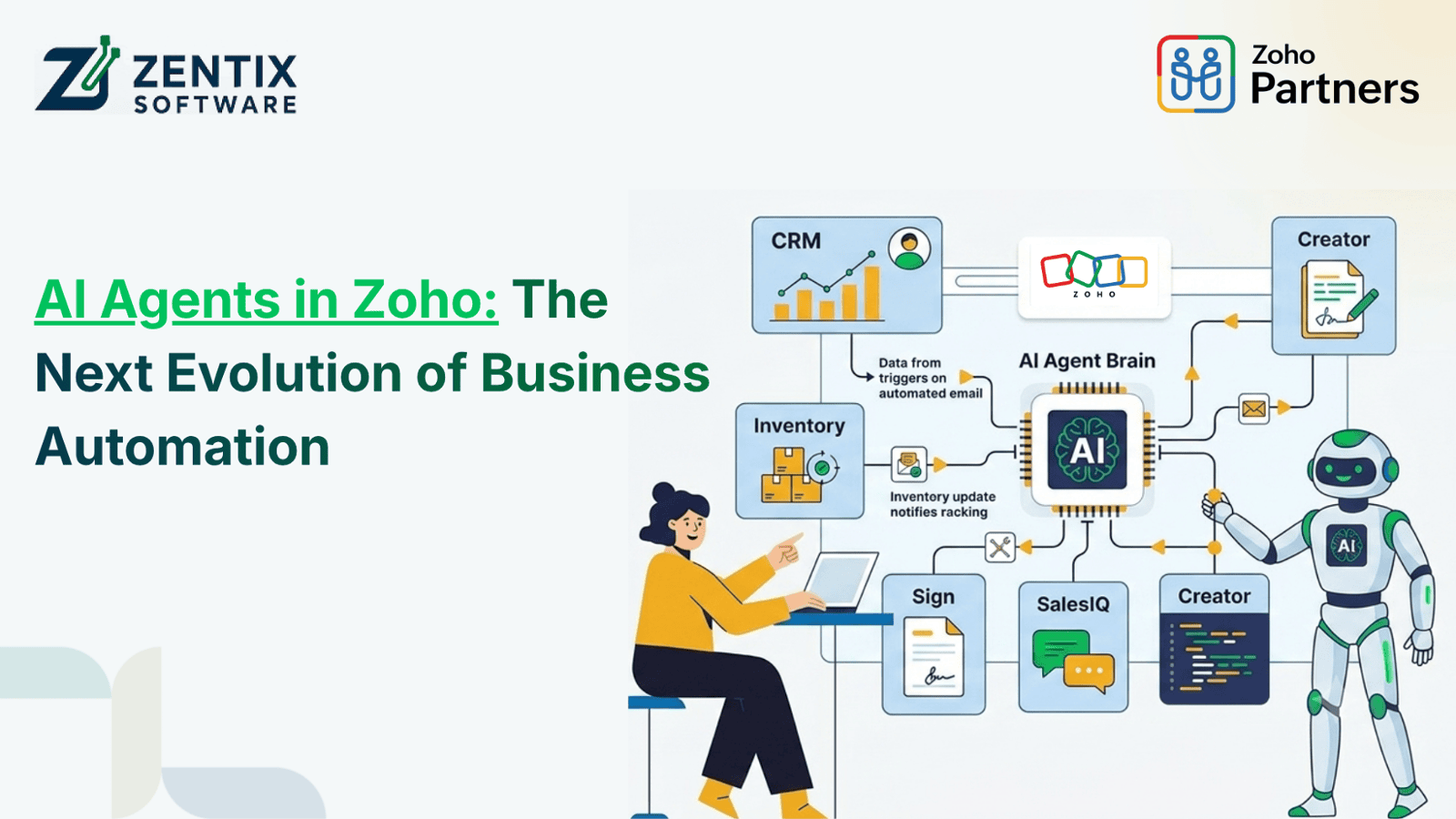
Businesses have spent years automating repetitive tasks with workflows, rules, and integrations. But traditional automation usually follows a fixed path: if this happens, then do that.
AI agents are changing that model.
Instead of simply following predefined instructions, an AI agent can understand a goal, evaluate the situation, choose the appropriate action, use connected business tools, and adapt when circumstances change. This is why AI Business Automation is moving from simple task automation toward more autonomous business operations.
Zoho is taking this approach further with Zoho AI Agents and Zia Agent Studio, where businesses can build, test, and deploy intelligent agents for sales, customer support, marketing, finance, and other operational functions. Zoho describes its agents as systems that can understand goals, connect with tools, automate workflows, make decisions, and adapt based on context.
What Are AI Agents in Zoho?
A Zoho AI agent is more than a chatbot or automated workflow.
A conventional workflow might send an email whenever a new lead enters the CRM. An intelligent agent can go several steps further:
Understand the new lead.
Research relevant information.
Evaluate the lead against defined criteria.
Update the CRM.
Decide what action should happen next.
Draft or send an appropriate follow-up.
Escalate the situation to a human when necessary.
This makes Intelligent AI Agents particularly useful for processes that involve multiple steps and decisions.
Zoho's Zia Agent Studio provides a visual environment where businesses can build agents, connect them with business applications, test them in a sandbox, and monitor their performance.
Traditional Automation vs. AI Agent Automation
The difference becomes easier to understand when the two approaches are compared.
Traditional Automation | AI Agent Automation |
Follows predefined rules | Works toward a defined goal |
Usually follows a fixed sequence | Can determine the next appropriate action |
Best for predictable processes | Useful for dynamic processes |
Limited decision-making | Can analyze context and make decisions |
Requires detailed workflow logic | Can be created using natural-language goals |
Usually handles individual tasks | Can coordinate multiple tasks and tools |
Human intervention may be needed frequently | Can operate autonomously within defined permissions |
This does not mean traditional automation is becoming obsolete. Instead, AI agents can complement existing workflows by handling situations where rules alone are not enough.
How Zoho AI Agents Work
The basic process is surprisingly straightforward.
1. Start With a Business Goal
Instead of designing every individual step first, businesses can begin with the desired outcome.
For example:
“Qualify new leads and follow up with prospects that match our ideal customer profile.”
The agent can then be configured around that objective.
2. Connect the Required Tools
An agent needs access to the systems where work happens. Zoho Agent Studio allows agents to connect with business tools through integrations and APIs.
This can allow an agent to retrieve information, update records, send emails, create records, or trigger workflows.
3. Give the Agent Business Context
An agent needs reliable information to make useful decisions.
Businesses can provide resources such as:
Product information
Company policies
FAQs
Customer information
Process documentation
Previous interactions
Internal knowledge bases
With appropriate context and permissions, the agent can make decisions based on more than the immediate question or event.
4. Test Before Deployment
One of the important steps is testing.
Zia Agent Studio provides a sandbox environment where businesses can simulate scenarios and observe how an agent responds before putting it into production.
5. Deploy and Monitor
After testing, an agent can be connected to business applications or deployed as a digital employee with its own role and permissions.
Businesses can then monitor performance and improve the agent over time.
Read Next:Zoho AI Agents: How Businesses Are Automating Workflows in 2026
Where Can Intelligent AI Agents Be Used?
The strongest applications are usually processes where employees spend significant time collecting information, making routine decisions, and taking repetitive actions.
Sales
Sales teams can use agents to:
Research incoming prospects
Qualify leads
Update CRM records
Prepare customer information
Trigger follow-ups
Route leads to the appropriate team
For example, when a new lead arrives, one agent could research the prospect while another evaluates the lead and another prepares a personalized follow-up.
Zoho specifically highlights this type of multi-step sales workflow in its Agent Studio examples.
Customer Support
Customer service teams can use agents to classify incoming tickets, prepare responses, identify priority issues, and escalate cases requiring human intervention.
This is especially useful outside normal working hours, when an agent can help organize incoming requests before the support team returns.
Marketing
Marketing teams can use agents for research, campaign monitoring, reporting, content-related workflows, and alerts.
Instead of manually checking multiple dashboards, an agent can monitor defined metrics and bring important changes to the team's attention.
Finance
Finance is another area with substantial automation potential.
Agents can assist with processes such as:
Invoice processing
Data extraction
Purchase-order matching
Exception identification
Fraud-related alerts
Routine financial workflows
Zoho's Agent Studio examples include invoice processing and fraud detection use cases.
Why AI Business Automation Matters
The value of AI Business Automation is not simply about reducing the number of clicks employees make.
The bigger opportunity is changing how teams spend their time.
Key benefits include:
Faster response times: Agents can operate continuously instead of waiting for employees to become available.
Higher productivity: Employees can spend less time on repetitive administrative work.
Scalability: Businesses can handle increasing volumes without every additional task requiring additional manual effort.
Consistent execution: Agents can follow defined processes consistently.
Better decision support: Agents can combine business context with available data before taking an action.
Human focus where it matters: Employees can concentrate on strategy, relationships, creativity, and high-value decisions.
Zoho also supports human-in-the-loop controls, allowing businesses to require human approval for sensitive or high-stakes actions.
Read Next:How AI Workflow Automation Is Replacing Manual Processes in CRM, HR & Finance
What Makes Zoho's Approach Different?
The broader Zoho ecosystem gives businesses an important advantage: agents can work with business applications, data, APIs, and workflows instead of operating as isolated AI tools.
Zia Agent Studio also supports multi-agent orchestration, where a primary agent can coordinate multiple specialized agents. One agent may collect information, another may process it, and another may perform the required action.
Zoho's wider agent platform also includes an Agent Store with pre-built agents, Agent Studio for custom agents, Zoho-hosted LLM options, and Zoho MCP for connecting external LLMs with Zoho APIs, data models, and actions.
This creates an ecosystem where businesses can move from isolated AI experiments toward connected business automation.
Should Every Business Use AI Agents?
Not necessarily.
The best starting point is not “Where can we use AI?” but:
“Which business process is repetitive, time-consuming, measurable, and suitable for controlled automation?”
A good candidate usually has:
A clear business objective
Repetitive manual work
Accessible business data
Defined rules or boundaries
A measurable outcome
A clear escalation path for humans
For sensitive processes, businesses should also define permissions, approvals, security controls, and fallback procedures before deployment.
The Future of Business Automation Is Agentic
Traditional automation taught software to follow instructions.
AI agents are moving toward software that can understand objectives, reason about situations, use tools, and take action.
That does not mean businesses should remove people from every process. In fact, the strongest approach is often a combination of AI and human expertise.
Agents can handle repetitive execution while people remain responsible for judgment, relationships, strategy, and decisions that require context or accountability.
For businesses already using Zoho applications, this creates an interesting opportunity. Instead of adding another disconnected AI tool, companies can explore how Zoho AI Agents can work across their existing business environment.
Final Takeaway
Intelligent AI Agents represent the next stage of automation because they can move beyond fixed workflows and participate in multi-step business processes.
With Zia Agent Studio, businesses can build, test, deploy, connect, and monitor agents for practical use cases across sales, support, marketing, finance, and other functions.
The goal isn't to automate humans out of the business.
The goal is to automate the work that prevents humans from doing their best work.
If your business is exploring Zoho services and wants to identify where AI agents can improve workflows, productivity, and scalability, the right strategy starts with understanding your existing processes and choosing the right automation opportunities.
Ready to explore what's possible with Zoho AI? Contact Zentix Software to discuss your business requirements and discover how AI-powered automation can fit into your existing Zoho ecosystem.
Book Your Live Demo Now.