
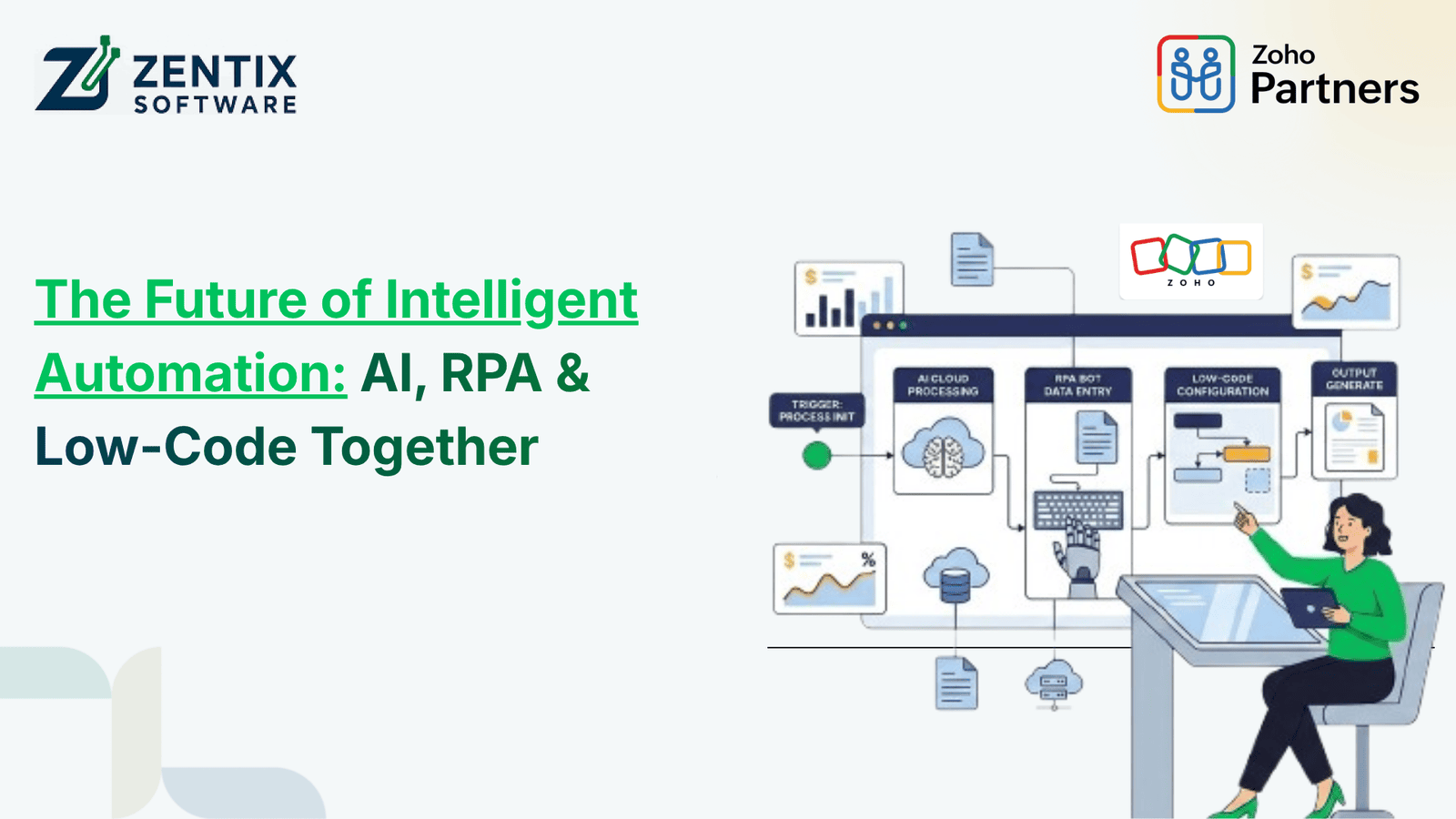
Companies do not just look at automation as a way to stop doing the boring tasks anymore. Today, automation is a part of how companies work, how companies make choices, how companies help customers, and how companies grow. When you put AI Automation, Robotic Process Automation (RPA), and Low-Code Automation together, you get a smarter way to work. This new way lets technology handle more than small jobs; technology can now handle decisions, workflows, and full business processes.
If your company is already using or looking into Zoho Services, this change is a chance for you. You can now link automation with easy low-code apps and your existing business systems.
What Is Intelligent Automation?
Intelligent automation brings together technologies such as AI, RPA, workflow automation, and low‑code development to create connected business processes.
Traditional RPA is mainly designed to follow predefined rules. AI adds the ability for RPA to understand information, identify patterns, generate responses, and support decision‑making. Low‑code platforms then make it easier for businesses to customize applications and workflows without building everything from scratch.
I think that together these technologies create automation that's more adaptable and useful across different departments.
The Three Technologies Working Together
AI Automation brings intelligence to business processes. It can analyze data, understand documents, summarize information, generate content, and support business decisions.
RPA handles repetitive, rule-based digital tasks such as data entry, copying information between applications, report generation, and routine updates.
Low-Code Automation allows businesses to quickly build customized applications, forms, workflows, and integrations with minimal traditional coding.
Instead of treating these technologies as separate solutions, businesses can combine them into a single automation strategy.
Why AI and RPA Are Better Together
RPA is highly effective when a process follows clear rules. However, many real-world business processes contain unstructured information and require some level of interpretation.
For example, consider an invoice approval process. RPA can collect invoice information and move it between systems. AI can help identify important information from the document, classify the invoice, or flag unusual patterns. A workflow can then route the invoice to the appropriate person for approval.
This creates a more intelligent process than traditional task automation alone.
The result is not simply automation that works faster, but automation that can respond to different types of business information.
How Low-Code Changes Business Automation
One of the biggest challenges with automation is making solutions flexible enough for changing business requirements.
Low-code platforms address this challenge by allowing teams to create applications and workflows through visual development tools, predefined components, forms, integrations, and automation logic.
With Zoho Creator, businesses can build customized applications around their existing processes rather than forcing every process into a standard software workflow.
For example, a company could create a custom approval application that connects sales, finance, inventory, and customer information. Automated workflows can then move information between departments while reducing manual follow-ups.
This makes low-code particularly valuable when businesses need automation that is customized but still quick to develop.
The Role of Zoho RPA Solution in Intelligent Automation
A Zoho RPA Solution can become an important part of a broader automation ecosystem. Instead of replacing existing applications, RPA can help connect repetitive tasks across business systems.
Common use cases include:
Automating repetitive data-entry activities
Moving information between business applications
Generating and distributing reports
Automating routine administrative tasks
Supporting finance and invoice workflows
Reducing repetitive customer-service activities
Synchronizing information across systems
When RPA is combined with AI and low-code applications, businesses can move beyond isolated automation and create connected workflows.
Zoho Creator + AI + RPA: A More Flexible Approach
The combination of Zoho Creator, Zoho AI and RPA can help businesses create automation around their unique requirements.
Imagine a sales organization receiving hundreds of customer inquiries.
A low-code application can capture and organize the leads. AI can help analyze or categorize incoming information. Automated workflows can assign leads to the right team members, while RPA can handle repetitive updates across connected systems.
The entire process can operate with fewer manual steps.
This approach is especially useful for growing businesses because automation can evolve as processes change.
Key Benefits of AI-Powered Low-Code Automation
1. Faster Process Execution
Automated workflows can complete repetitive tasks significantly faster than manual processes, helping employees spend more time on higher-value activities.
2. Fewer Manual Errors
Automation reduces the need for repetitive data entry and manual information transfer, which can help improve consistency.
3. Faster Application Development
Low-code development allows businesses to build and modify applications without relying entirely on traditional software development cycles.
4. Better Decision Support
AI can analyze large amounts of information and provide insights that help employees make faster, more informed decisions.
5. Easier Scalability
Once a successful automated workflow is established, businesses can expand it across additional teams, processes, or locations.
6. Better Employee Productivity
Automation does not have to replace employees. Its greater value often comes from removing repetitive work so employees can focus on customer relationships, strategy, problem-solving, and innovation.
What Will the Future of Automation Look Like?
The next step in automation is probably going to focus on single bots and more on smart systems that work together.
Companies are going to start mixing AI agents, RPA bots, workflow automation, low-code tools, and business data to build processes that can change and adapt when situations change.
For instance, an automated workflow might notice a customer message, figure out what it means using AI, get the information, update company systems, and tell the right person. All in one system that works as a whole.
This shows a move from doing tasks to having smart processes.
Is Intelligent Automation Right for Your Business?
Businesses should not automate everything simply because automation is available. The best starting point is identifying processes that are repetitive, time-consuming, rule-based, or dependent on multiple systems.
Ask questions such as:
Which tasks consume the most employee time?
Where do manual errors occur frequently?
Which processes involve repetitive data entry?
Which workflows require information from multiple applications?
Where could AI improve decision-making?
Which processes would benefit from a customized low-code application?
The answers can help identify where AI Automation, Low-Code Automation, and RPA can deliver measurable value.
Build the Next Generation of Business Automation
The future of automation is not about picking between AI, RPA, or low‑code development. The future of automation is about joining these technologies to make smarter, more connected, and more adaptable business processes.
With Zoho Services, businesses can combine intelligent automation, customized applications, workflows, and integrations to improve operational efficiency and build a stronger foundation for future growth.
At Zentix Software, we help businesses find automation opportunities and build solutions around their workflows using the Zoho ecosystem.
Ready to make your business processes smarter? Submit the contact form andBook Your Live Demo Nowto explore the right automation strategy for your business.