
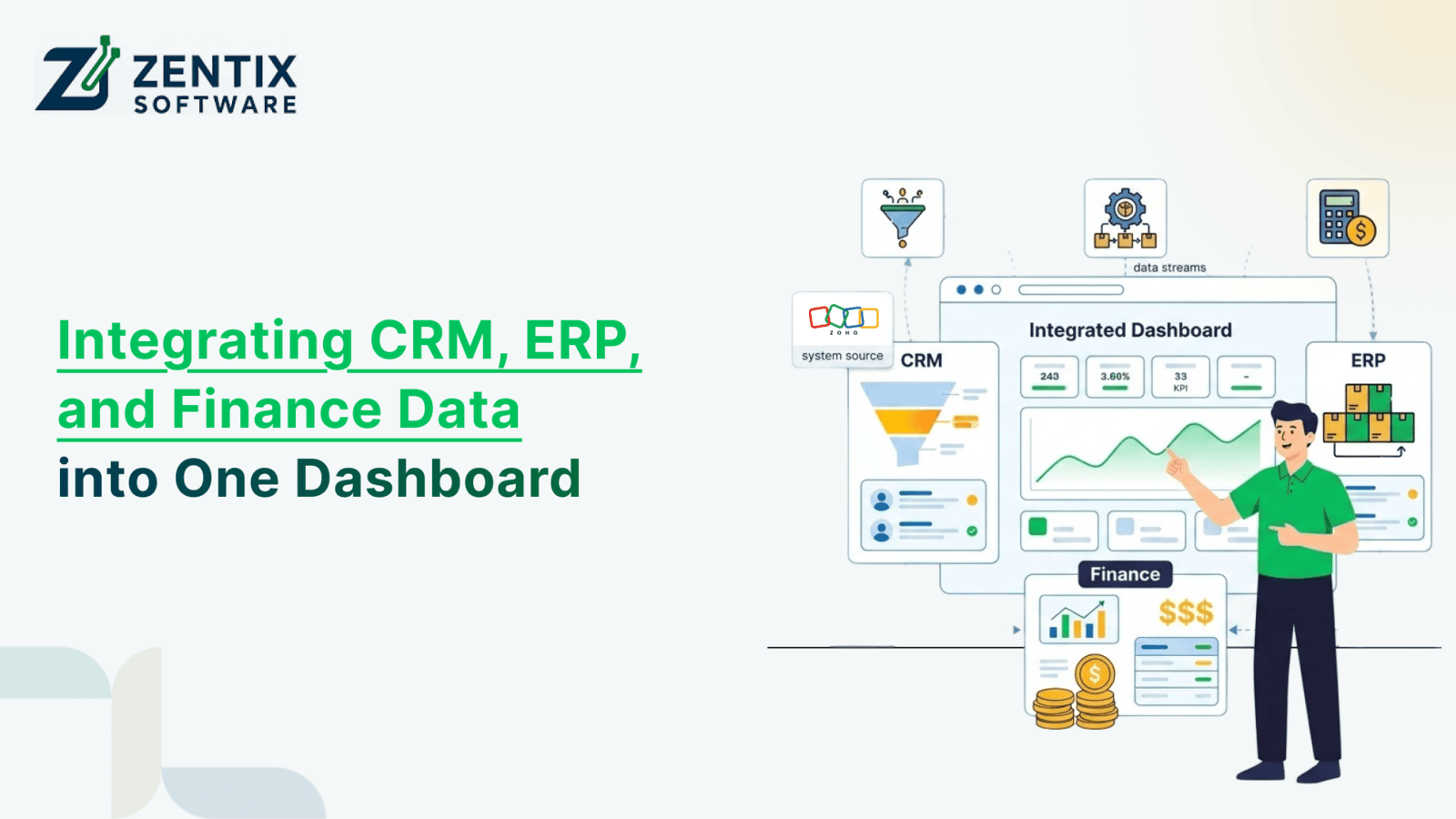
With the rapid pace of business, companies are creating data from various systems every day. Sales teams use Zoho CRM in-house, operations teams use Zoho ERP, and finance teams use Zoho Finance to manage records, and leadership teams require accurate reports to help them make strategic decisions. The problem is that this data is often spread across multiple platforms, and it's hard to get the big picture of business performance.
Here, Zoho Integration and Zoho Analytics are proving to be invaluable. CRM, ERP, and financial data are consolidated into a single platform, providing businesses with real-time data and insights, better decision-making, and automated reporting.
Businesses need to build connected ecosystems where critical data flows seamlessly from one application to another, to enable them to operate their businesses smarter and faster.
Why Businesses Struggle with Disconnected Data?
Many organizations use multiple software solutions to manage different business functions. While each application performs its specific role effectively, problems arise when data remains isolated.
For example:
Sales teams track leads and customers in Zoho CRM.
Inventory and operations are managed through Zoho ERP.
Accounting and financial records are maintained in Zoho Finance tools.
Managers often export spreadsheets from different systems to prepare reports.
This process consumes valuable time and increases the risk of errors. Decision-makers may not have access to real-time information, resulting in delayed responses to business challenges.
Without proper Zoho Integration, businesses often face:
Duplicate data entry.
Reporting inconsistencies.
Reduced productivity.
Delayed decision-making.
Lack of visibility across departments.
A unified dashboard solves these challenges by providing one source of truth for the entire organization.
What Is a Unified Business Dashboard?
A single dashboard provides a single place for all systems to view data. Users can get key metrics without having to change between apps.
Zoho Analytics enables businesses to connect data from Zoho CRM, Zoho ERP, and Zoho Finance applications to make customised reports and dashboards.
This approach enables teams to:
Monitor sales performance.
Track financial health.
Analyze operational efficiency.
Forecast future trends.
Make data-driven decisions.
Rather than spending hours collecting information, leaders can focus on acting on insights.
Read Next:Boost Efficiency with Zoho CRM Integration and Expert ERP Integration Solutions
The Role of Zoho CRM in a Unified Dashboard
Zoho CRM is like the place where we keep all the information about our customers. It helps us get all the details from people who're interested in our products, the ones who might buy from us, the people who already buy from us, and what our sales team is doing.
When integrated into a centralized dashboard, Zoho CRM provides valuable insights such as:
Lead generation performance.
Sales pipeline status.
Conversion rates.
Customer acquisition costs.
Revenue forecasts.
When we connect Zoho CRM with systems that our business uses, we get a better idea of how what our customers do affects the way our company runs and makes money.
For example, the people who sell things for our company can see if we have something in stock before they finalize a sale, and the people who handle money can see how much money is coming in from specific groups of customers.
How Zoho ERP Enhances Operational Visibility
Operational efficiency plays a major role in business success. Zoho ERP helps businesses manage inventory, procurement, manufacturing, supply chain processes, and other operational functions.
When Zoho ERP data is connected through Zoho Integration, businesses gain visibility into:
Inventory levels.
Order fulfillment status.
Production schedules.
Vendor performance.
Supply chain efficiency.
When combined with customer and financial data, operational data can help management teams pinpoint bottlenecks and enhance business performance in general.
For example, if sales of a product are projected to rise substantially, managers can easily find out if the inventory level is sufficient to match the sales increase.
Bringing Financial Insights Together with Zoho Finance
Financial data is essential for evaluating business performance. Zoho Finance applications provide detailed information about accounting, invoicing, expenses, cash flow, and profitability.
Integrating Zoho Finance data into a centralized dashboard helps organizations monitor:
Revenue trends.
Outstanding invoices.
Expense management.
Profit margins.
Cash flow performance.
No more manual reporting of financial information by finance teams. Financial data is updated in real time, giving businesses fast access to information to react to market fluctuations.
By integrating Zoho Finance with Zoho CRM and Zoho ERP, businesses can enjoy a comprehensive view of customer transactions, business performance, and financial results.
Read Next:Custom Finance Workflow Automation Using Zoho Creator
Why Zoho Analytics Is the Key to Unified Reporting
While data exists across multiple applications, Zoho Analytics acts as the intelligence layer that transforms raw information into actionable insights.
With Zoho Analytics, businesses can:
Connect multiple Zoho applications.
Create interactive dashboards.
Generate automated reports.
Monitor KPIs in real time.
Use AI-powered insights.
Share reports securely across teams.
A massive benefit of Zoho Analytics is that it can combine data from multiple sources, without having to be a technical expert.
Customizable dashboards allow decision-makers to view the metrics that are most relevant to them, eliminating the need for tedious spreadsheets and disjointed reporting systems.
Benefits of Zoho Integration Across CRM, ERP, and Finance
A successful Zoho Integration strategy delivers benefits across every department.
1. Real-Time Business Visibility
When all systems are connected, business leaders can view real-time information instead of relying on outdated reports.
2. Improved Decision-Making
Accurate and consolidated data helps managers make faster and more informed decisions.
3. Reduced Manual Work
Automated data synchronization eliminates repetitive tasks and reduces human errors.
4. Better Customer Experience
Sales, finance, and operations teams can access the same customer information, resulting in faster responses and improved service.
5. Increased Productivity
Employees spend less time gathering data and more time focusing on strategic initiatives.
6. Enhanced Reporting Accuracy
Unified reporting minimizes discrepancies and ensures consistency across departments.
Read Next:How a Zoho Integration Expert with AI Agents Cuts Costs and Saves Time
Common Use Cases for Integrated Zoho Dashboards
Businesses across industries are using integrated dashboards to improve performance.
Sales and Revenue Tracking
By combining Zoho CRM and Zoho Finance, companies can monitor sales performance alongside revenue collection and profitability.
Inventory and Order Management
Integrating Zoho ERP with sales data helps businesses track inventory levels and prevent stock shortages.
Executive Performance Dashboards
Leadership teams can view high-level KPIs from sales, operations, and finance in one place.
Customer Profitability Analysis
Businesses can analyze which customers generate the highest revenue while considering operational and financial costs.
Forecasting and Planning
Historical data from Zoho CRM, Zoho ERP, and Zoho Finance can be used to create accurate forecasts and growth plans.
Why Businesses Choose Zentix Software for Zoho Integration
Implementing a successful integration strategy requires careful planning and technical expertise. Every business has unique workflows, reporting requirements, and operational goals.
As a Certified Zoho Service Provider, we specialize in:
Zoho CRM implementation.
Zoho ERP integration.
Zoho Finance integration.
Zoho Analytics dashboard development.
Custom workflow automation.
API integrations.
Advanced reporting solutions.
Our team works with businesses to figure out what they need. Then we build custom dashboards for them. These dashboards give businesses the information they need to make decisions.
If you want to make your reports better, make your work easier, or see what is going on in all parts of your company, we can help you with that.
We can help you set up a Zoho ecosystem that is connected and helps your business grow over time.
Conclusion
Data is really important for a business. It is only useful when we can see everything together and get to it easily. When we put Zoho CRM, Zoho ERP, and Zoho Finance together in one place using Zoho Analytics, businesses can see everything that is going on. They can see how things are working, what customers are like. How money is being made.
Having everything in one place means we do not have to look at lots of reports, which helps us make better decisions, and it helps businesses work better. If we use Zoho Integration, the way businesses can take all the different pieces of data and turn them into things that really help them grow. Zoho Integration can make a difference for businesses, and Zoho CRM, Zoho ERP, and Zoho Finance are all important parts of that.
Book Your Live Demo Now
Ready to unify your business data and unlock real-time insights?
Zentix Software can help you integrate Zoho CRM, Zoho ERP, Zoho Finance, and Zoho Analytics into one powerful dashboard tailored to your business needs.
Book Your Live Demo Now and discover how connected data can accelerate your business growth.