Introduction: Most Businesses Are Sitting on Valuable CRM Data Without Realizing It
Over the last few years, businesses have become much better at collecting customer data. Every inquiry form, sales call, support request, follow-up email, and customer interaction gets stored somewhere inside the CRM. But collecting data and actually using it well are two very different things.
For many companies, the CRM becomes little more than a digital contact book. Sales teams update lead statuses, managers check monthly reports, and marketing departments track campaigns. Beyond that, the data rarely contributes to bigger business decisions.
That is where predictive analytics changes the conversation.
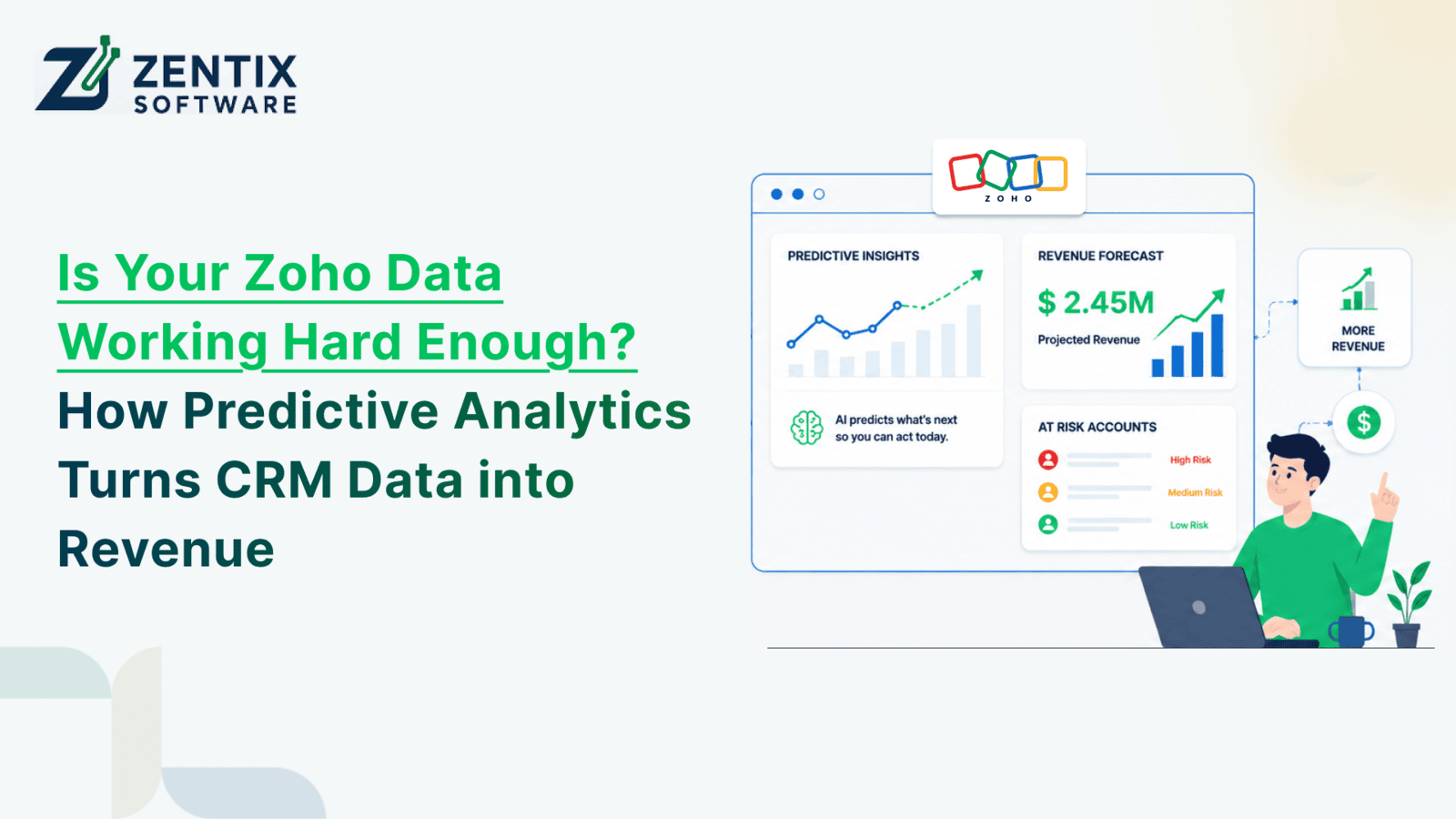
Instead of only showing what has already happened, modern CRM systems can now help businesses understand what is likely to happen next. Which leads are most likely to close? Which customers may stop engaging? Which opportunities deserve immediate attention? These are the kinds of questions businesses can answer using Zoho predictive AI.
The companies growing fastest today are not necessarily collecting more data than everyone else. They are simply using their data more intelligently.
At Zentix Software, we regularly work with businesses that already have strong customer data inside their CRM but struggle to turn it into real business value. With the right Zoho Consulting strategy, AI Workflow Automation, and analytics setup, that same data can become a reliable source of revenue insights and operational efficiency.
The Real Issue: Businesses Have Data, But Not Direction
Most organizations already know data is important. The problem is that their systems are often disconnected, outdated, or heavily dependent on manual work.
We see this all the time.
Sales teams manage leads in one place. Marketing teams pull reports from another platform. Customer support operates separately. Management teams end up relying on spreadsheets to combine everything.
The result is usually:
Delayed reporting
Poor visibility
Slow decision-making
Missed sales opportunities
Inefficient workflows
Even businesses with a well-implemented CRM can struggle because they are only using basic functionality.
A common example is lead management. Many sales teams spend equal time on every inquiry without knowing which prospects are actually serious buyers. Some high-potential opportunities get ignored while time is wasted chasing leads that were never likely to convert in the first place.
Another issue is reactive decision-making.
Most businesses only notice problems after they have already impacted revenue:
Customers stop responding
Sales pipelines slow down
Targets are missed
Retention rates drop
Without predictive insights, teams are constantly reacting instead of planning.
This is exactly why businesses are starting to invest more heavily in Predictive AI Analytics Solutions. They want systems that not only store information but also help interpret it in a meaningful way.
What Is Zoho Predictive AI?
Zoho predictive AI helps businesses make smarter decisions by analyzing historical CRM data, customer behavior, sales activity, and operational trends.
Instead of manually reviewing reports and trying to identify patterns, the system does much of the heavy lifting automatically.
For example, Zoho predictive AI can help businesses:
Identify which leads are more likely to convert
Forecast future sales trends
Detect customer churn risks
Recommend workflow actions
Highlight sales bottlenecks
Improve forecasting accuracy
The biggest advantage is that businesses no longer need to rely entirely on assumptions or gut instinct.
A sales manager can quickly see which deals require attention. A customer success team can identify accounts showing early warning signs. Leadership teams can make decisions using live performance insights rather than outdated monthly reports.
This creates a much more proactive business environment.
How Predictive Analytics Actually Drives Revenue
Predictive analytics sounds technical, but the impact is very practical. When businesses understand patterns inside their CRM data, they make better decisions, respond faster, and reduce wasted effort.
Over time, that directly affects revenue growth.
Better Lead Prioritization
Not all leads deserve the same amount of attention.
Some prospects are ready to buy immediately, while others may simply be exploring options. Predictive analytics helps sales teams focus on the leads most likely to move forward.
Instead of guessing, teams can prioritize based on:
Engagement history
Response activity
Industry trends
Previous conversion patterns
This helps improve close rates and shortens the sales cycle.
Spotting Customer Churn Early
One of the most valuable uses of predictive analytics is identifying customer dissatisfaction before the relationship is lost completely.
Small warning signs often appear early:
Reduced communication
Lower engagement
Delayed renewals
Fewer purchases
Increased support issues
When businesses notice these trends early enough, they can step in proactively instead of reacting after the customer leaves.
That alone can save significant long-term revenue.
More Accurate Revenue Forecasting
Traditional forecasting methods are often based on estimates and spreadsheets. Predictive analytics adds far more context to the process.
Businesses can identify:
Expected revenue trends
Pipeline risks
Seasonal patterns
Performance gaps
High-value opportunities
This helps leadership teams plan more confidently and allocate resources more effectively.
Creating More Personalized Customer Experiences
Customers respond better when communication feels relevant and timely.
With better CRM insights, businesses can personalize:
Follow-ups
Product recommendations
Marketing campaigns
Service interactions
Customer journeys
This improves both engagement and conversion rates without requiring teams to manually manage every interaction.
Why AI Workflow Automation Matters More Than Ever
One of the biggest operational problems businesses face today is manual work.
Employees spend hours every week:
Updating records
Sending reminders
Managing approvals
Assigning tasks
Creating reports
Following up manually
These tasks may seem small individually, but together they consume a huge amount of time.
AI Workflow Automation helps remove many of these repetitive processes.
For example, businesses can automate:
Lead assignments
Email follow-ups
Approval requests
Notifications
Customer onboarding workflows
CRM updates
Instead of employees constantly handling routine administrative work, the system manages it automatically in the background.
This improves consistency while also giving teams more time to focus on high-value work.
At Zentix Software, many of our automation projects focus on reducing operational friction. Businesses are often surprised by how much time they recover once repetitive workflows are streamlined properly.
Why Zoho BI and Analytics Is Becoming Essential
Having access to data is one thing. Being able to understand it clearly is something else entirely.
This is where Zoho BI and analytics tools become extremely valuable.
Businesses today generate data from multiple sources:
CRM systems
Marketing platforms
Accounting software
Customer support systems
Sales tools
Inventory platforms
Without centralized reporting, it becomes difficult to see the full picture.
Zoho Analytics dashboards help businesses bring everything together in one place.
That visibility makes a major difference.
Management teams can quickly monitor:
Sales performance
Team productivity
Customer behavior
Revenue trends
Operational bottlenecks
Marketing effectiveness
Instead of spending hours preparing reports manually, teams can access live dashboards that update automatically.
For growing businesses, especially, this kind of visibility helps improve decision-making across every department.
Real-World Business Use Cases for Predictive AI
Predictive AI is not limited to large enterprises. Businesses across many industries are already using it to improve efficiency and profitability.
Manufacturing Companies
Manufacturers use predictive insights to forecast order demand, manage supplier workflows, and identify high-value accounts.
Real Estate Businesses
Real estate teams can prioritize serious buyers, automate nurturing campaigns, and improve response timing.
SaaS Companies
Software businesses often use predictive analytics to reduce customer churn and improve onboarding experiences.
Healthcare Organizations
Healthcare providers can improve appointment scheduling, patient communication, and service coordination.
Professional Service Firms
Agencies and consulting firms use predictive reporting to forecast workloads, manage client communication, and optimize project planning.
The common factor across all industries is simple: businesses want better visibility into what is happening and what is likely to happen next.
Why Working With an Experienced Zoho CRM Consultant Matters
Many businesses invest in CRM software expecting immediate results. But software alone rarely solves operational problems.
Without proper setup and planning, businesses often run into issues like:
Poor data organization
Inefficient workflows
Incomplete integrations
Inconsistent reporting
Low team adoption
This is where an experienced Zoho CRM consultant becomes valuable.
A good consultant helps businesses:
Structure CRM systems properly
Build scalable workflows
Improve reporting visibility
Connect systems
Automate repetitive processes
Align CRM usage with business goals
At Zentix Software, our focus is not just technical implementation. We work closely with businesses to understand how teams actually operate day to day, so the system supports real operational needs instead of creating additional complexity.
How Zentix Software Helps Businesses Use CRM Data More Effectively
At Zentix Software, we help businesses move beyond basic CRM usage and build systems that actively support growth.
Our services include:
Zoho CRM Setup and Customization
We tailor CRM systems around each business’s sales process, workflows, and operational structure.
AI Workflow Automation
We automate repetitive processes that slow teams down and create unnecessary manual work.
Zoho BI and Analytics Dashboards
We build reporting dashboards that provide real-time visibility into business performance.
Integration Services
We connect Zoho applications with third-party systems to improve data flow across departments.
Predictive Reporting Solutions
We help businesses use CRM data more strategically through forecasting, lead analysis, and operational insights.
For many businesses, the goal is not simply having more technology. The goal is to build systems that help teams work smarter and make better decisions consistently.
The Future of CRM Is Predictive, Automated, and Data-Driven
CRM platforms are changing quickly.
Businesses no longer want software that only stores customer information. They want systems that actively support decision-making, automate operations, and identify opportunities automatically.
Predictive AI will continue playing a major role in:
Revenue forecasting
Customer engagement
Workflow optimization
Sales performance
Operational planning
Businesses that adapt early will likely gain a strong advantage in efficiency, responsiveness, and scalability.
The companies that continue relying entirely on manual reporting and disconnected systems may struggle to keep pace as expectations continue evolving.
Conclusion
Most businesses already have valuable data sitting inside their CRM. The challenge is knowing how to use it effectively.
With the right combination of Zoho predictive AI, Zoho BI and analytics, and AI Workflow Automation, businesses can turn everyday CRM activity into meaningful business intelligence.
Predictive analytics helps organizations work more proactively, improve customer engagement, streamline operations, and make stronger business decisions using real-time insights.