
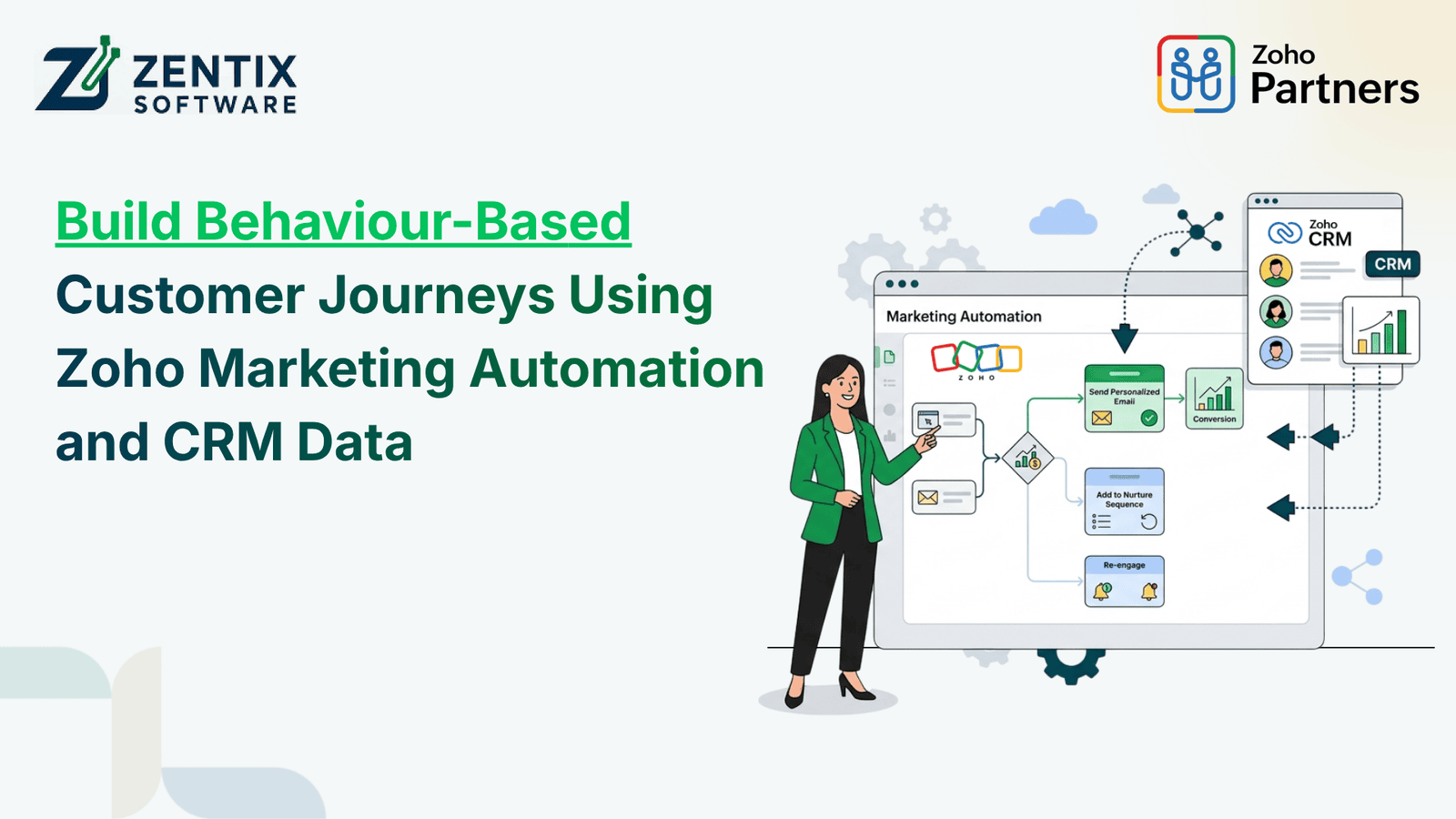
Consumers come into contact with organizations through various methods prior to buying. For example, consumers may visit a website, download a document, open an email, inquire about a product, or talk to a salesperson. The contacts are very informative for understanding customer behaviour, interest, and intent.
The one-size-fits-all approach to sending marketing communications to all customers does not account for the diverse needs of customers. Organizations should take a more personalized approach and react to customers' behaviour rather than stick solely to predetermined marketing schedules.
Behavior-based customer journeys can be helpful here. Through using Zoho Marketing Automation along with Zoho CRM, organizations can implement automated communications according to customers' behaviour, level of engagement, and sales activities..
What Are Behaviour-Based Customer Journeys?
Behaviour driven customer journeys are processes of marketing and communication that depend on how customers interact with the business. The marketing and communication process does not take place on schedule but depends on certain actions by the customer for the system to communicate back.
In an example, when a visitor downloads a product guide, the next communication is an email relating to the same product. In case the visitor wants a demo of the same product, the visitor's information may be updated in the CRM and relevant communication made.
Common behavioural triggers include:
Website visits and page interactions.
Email opens and link clicks.
Form submissions and resource downloads.
Product enquiries and demo requests.
Previous purchases and customer activity.
Changes in lead status or sales stage.
These actions help businesses understand customer interests and build communication journeys that reflect their actual requirements.
Why Combine Zoho Marketing Automation with Zoho CRM Data?
Marketing automation works better when it is integrated with the information about customers and sales. Zoho Marketing Automation can be used to handle campaigns, monitoring of customer engagement, and automation of customer communication, whereas Zoho CRM will provide information about leads and sales contacts.
Integration of both applications will help marketing and sales teams have an integrated view of the customer activities.
Here are some important advantages:
1. Better Customer Segmentation
Businesses can group contacts based on their interests, engagement, purchase history, and lead status. This makes it easier to deliver relevant campaigns instead of sending identical messages to everyone.
2. Personalised Communication
Customer information stored in Zoho CRM can help businesses understand individual requirements. Marketing teams can use relevant information to create more meaningful email campaigns and follow-ups.
3. Improved Lead Nurturing
Not every lead is ready to make a purchase immediately. Automated journeys help businesses maintain communication with potential customers by sharing useful information based on their interactions.
4. Better Marketing and Sales Coordination
When marketing engagement and CRM information are connected, sales representatives can gain better context about a lead before contacting them. This supports more informed conversations and follow-ups.
5. More Efficient Workflow Automation
Automating repetitive marketing activities reduces manual work. Teams can spend more time understanding customer needs, improving campaigns, and managing important sales opportunities.
How to Build Behaviour-Based Customer Journeys Using Zoho
Creating an effective customer journey requires more than setting up automated emails. Businesses need to understand their audience, identify meaningful behavioural triggers, and define what should happen after each interaction.
The following steps explain how to approach this process.
1. Identify Your Customer Journey Stages
Start by understanding how customers move from their first interaction with your business to becoming paying customers.
A typical customer journey includes:
Awareness: A potential customer discovers your business through search engines, social media, or other marketing channels.
Interest: They explore your website, read blogs, or download resources.
Consideration: They compare solutions, request information, or attend product demonstrations.
Decision: They evaluate pricing, discuss requirements, and prepare to make a purchase.
Retention: Existing customers receive updates, support information, and relevant product recommendations.
Mapping these stages helps marketing teams determine which messages and actions are appropriate at each point.
2. Collect and Organise Customer Data in Zoho CRM
The next step is to maintain accurate customer information in Zoho CRM. This information provides the foundation for building relevant customer journeys.
Important CRM data may include:
Contact details and company information.
Lead source and campaign information.
Product or service interests.
Previous enquiries and interactions.
Lead status and sales pipeline stage.
Purchase and customer history.
Organising this information properly makes customer segmentation easier. It also helps teams identify which contacts need additional information, sales assistance, or ongoing engagement.
3. Define Behavioural Triggers
Behavioural triggers determine when an automated journey should begin or when a contact should move to another stage.
For example, a visitor who downloads an industry-specific guide may receive an educational email sequence. Someone who visits a pricing page multiple times may be considered a stronger potential lead, depending on their other interactions.
Some practical trigger examples include:
Customer Behaviour | Possible Automated Action |
Downloads an eBook | Send a related educational email |
Clicks a product link | Share additional product information |
Submits an enquiry form | Create or update a CRM lead |
Requests a demo | Notify the relevant sales representative |
Stops engaging with emails | Add to a re-engagement journey |
Completes a purchase | Start a customer onboarding sequence |
The objective is to make every automated action relevant to the customer's previous interaction.
4. Create Automated Workflows in Zoho Marketing Automation
Once behavioural triggers are identified, create workflows that define what happens after each customer action.
For example, consider a business offering software solutions. When a potential customer downloads a guide about business automation, the workflow could:
Add the contact to a relevant audience segment.
Send a confirmation email with the downloaded resource.
Wait for a defined period.
Share additional information about related solutions.
Check whether the contact interacts with the email.
Send a relevant follow-up based on engagement.
If the contact submits a demo request, the journey can move towards sales follow-up rather than continuing with general educational emails.
This approach makes Workflow Automation more meaningful because each action is connected to customer behaviour.
5. Connect Marketing Engagement with Sales Activities
The marketing and sales departments need to use common customer data. The integration of Zoho Marketing Automation with Zoho CRM enables businesses to link marketing engagement with lead management and the sales process.
For instance, when a lead consistently interacts with product-based content and raises an inquiry, the customer record from the CRM could prove valuable for the sales team.
Businesses can use this information to:
Identify leads showing stronger purchase interest.
Assign leads to the appropriate sales representatives.
Record important customer interactions.
Trigger follow-up activities.
Track lead progression through the sales pipeline.
This connection helpsZoho Sales teams prioritise relevant opportunities and follow up with better context.
6. Personalise Communication Based on Customer Interests
Personalisation should go beyond including a customer's name in an email. Businesses should consider what the customer has explored, which products interest them, and what information they may need next.
For example:
A new subscriber may receive introductory information about your services.
A contact interested in a particular product may receive relevant features and use cases.
A prospect comparing solutions may receive comparison resources or a demo invitation.
An existing customer may receive product updates and useful educational content.
Businesses operating across multiple service categories can also use relevant Zoho Finance information, where appropriately integrated, to support customer communication around billing, payment updates, and financial processes.
The important point is to use customer data responsibly and ensure that every message provides genuine value.
7. Measure Performance and Improve Customer Journeys
Building a customer journey is not a one-time activity. Businesses should regularly review campaign performance and identify opportunities for improvement.
Important metrics include:
Email open rates.
Click-through rates.
Form submission rates.
Lead conversion rates.
Unsubscribe rates.
Sales-qualified leads.
Customer engagement and retention.
For example, if customers frequently open an email but do not click its links, the content or call to action may need improvement. If leads stop responding after the first follow-up, the timing or relevance of subsequent messages may need to be reviewed.
Regular performance analysis helps businesses improve their customer journeys over time.
Practical Example: A Behaviour-Based Customer Journey
Consider a company offering business software and automation services. A potential customer visits its website and downloads a guide about improving business operations.
Instead of sending a generic promotional email, the business can create a journey based on the customer's actions.
Stage | Customer Action | Automated Response |
1 | Downloads an automation guide | Send the resource by email |
2 | Opens the follow-up email | Share related educational content |
3 | Clicks the service page | Send relevant service information |
4 | Submits an enquiry form | Update the CRM record |
5 | Requests a consultation | Notify the sales team |
6 | Becomes a customer | Begin onboarding communication |
This example shows how marketing interactions and CRM information can work together to create a connected customer experience.
Rather than treating every contact as a new lead, businesses can use previous interactions to determine the next relevant step.
Common Mistakes to Avoid When Building Customer Journeys
Even with automation tools, poorly planned customer journeys can create unnecessary communication and reduce customer engagement.
Some common mistakes include:
Using Incomplete Customer Data: Inaccurate or outdated CRM records can lead to irrelevant communication. Keep contact information and lead details updated.
Creating Too Many Automated Messages: Sending frequent emails can overwhelm customers. Focus on useful communication rather than message quantity.
Ignoring Customer Behaviour: A journey should respond to actual interactions. Avoid continuing the same sequence when a customer has already completed an important action, such as requesting a demo or making a purchase.
Keeping Marketing and Sales Data Separate: Disconnected systems make it difficult for teams to understand the complete customer journey. Maintain consistent information between marketing and CRM processes.
Not Reviewing Campaign Performance: Automated workflows still require regular monitoring. Review engagement, conversion, and drop-off points to identify improvements.
How Zentix Software Helps Businesses with Zoho Implementation
Constructing an effective customer journey will involve the proper blend of technology, customer data, automation rules and business processes. Simply enabling the automation options is never enough; what a business needs is a well-organised strategy that combines marketing activities and sales process.
The company offers professional Zoho Consulting and implementation services in order to facilitate better utilisation of the Zoho ecosystem by businesses.
Due to profound knowledge about Zoho CRM, marketing processes and workflow automation, the specialists assist companies in integrating their processes into business needs.
In case of any needs for improvements in lead generation, automation of customer communication, application integration or sales processes, Zoho Implementation can be used to create more systematic business environment.
Conclusion
Customer journey based on behaviour allows companies to go beyond marketing campaigns that are just generic and work towards creating communication which is based on the interests and behaviours of customers.
Using Zoho Marketing Automation with Zoho CRM will allow companies to improve segmentation, automate lead nurturing, integrate marketing and sales operations, and increase relevance in the experiences of customers. The main point of success would be proper customer data collection, setting the right triggers for actions, making good workflows, and evaluation.
Ready to Improve Your Customer Journeys with Zoho?
Connect your marketing activities, CRM data, and business workflows with the right Zoho solutions. Partner with Zentix Software for expert guidance on Zoho consulting, implementation, customization, and workflow automation.
Book Your Free Live Demo with Zentix Software.